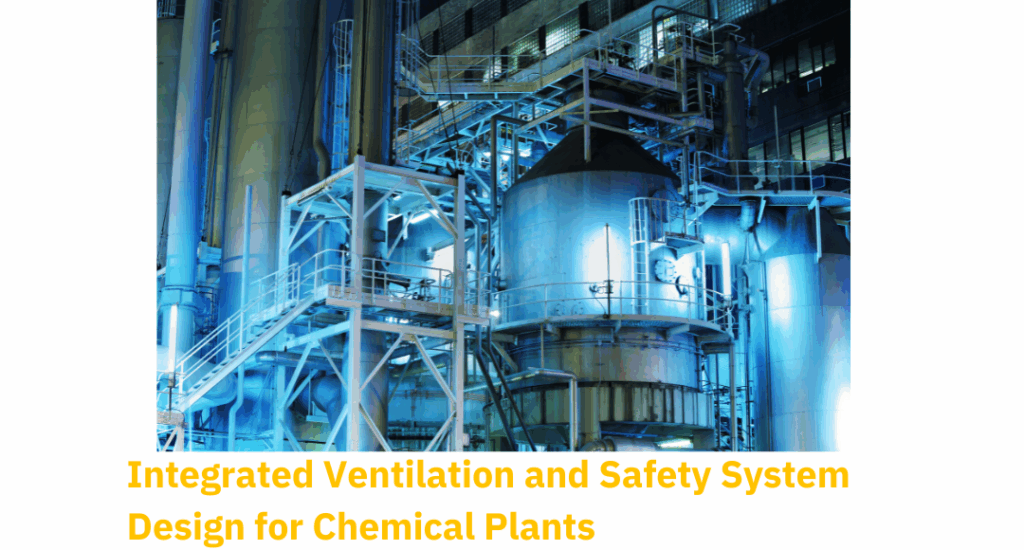
Integrated Ventilation and Safety System Design for Chemical Plants
Chemical plants operate in high-stakes environments where safety is paramount. A minor lapse in ventilation design can lead to hazardous vapor build-up, employee exposure to toxic substances, or even catastrophic explosions. That’s why an Integrated Ventilation and Safety System isn’t just ideal it’s essential.
In this post, we’ll explore how engineers and project managers can design ventilation systems that work hand-in-hand with safety systems, ensuring regulatory compliance, environmental responsibility, and operational efficiency without compromising on design elegance and functionality.
Why Integration Matters in Chemical Plants
Chemical plants deal with:
- Volatile Organic Compounds (VOCs)
- Combustible gases and dust
- Toxic fumes (e.g., ammonia, chlorine, sulfur compounds)
- Heat, humidity, and process-specific emissions
Challenges of Disjointed Systems
Without integration:
- Safety alarms may be triggered too late
- Ventilation may fail to respond dynamically
- Energy use increases due to inefficiencies
- Hazardous build-up may go unnoticed in inactive zones
An integrated approach ensures intelligent communication between sensors, alarms, exhaust systems, and controls.
Core Components of an Integrated Ventilation & Safety System
Component | Role in Integration |
Local Exhaust Ventilation (LEV) | Captures contaminants at the source before they disperse. |
General Dilution Ventilation | Maintains safe ambient air quality throughout the plant. |
Gas Detection Sensors | Monitors VOCs, oxygen levels, flammable gases, etc. |
Explosion-Proof Fans | Designed to handle combustible environments safely. |
Control Panels with IoT | Collects data and automates response actions like fan activation. |
Interlocks with Safety Devices | Ensures systems like alarms, shutoffs, and ventilation operate in sync. |
Emergency Ventilation Mode | Triggers high-volume ventilation in critical events. |
Design Considerations for Chemical Plants
1. Zoning the Facility
- Divide the plant into ventilation zones based on chemical types and exposure risk.
- Use demand-based controls to activate ventilation only in occupied or active zones, saving energy.
2. Source Capture First
- Always prioritize point-of-origin capture: hoods, snorkels, and fume arms.
- Integrate these with high-efficiency filters and ducted exhausts.
3. Sensor Placement Strategy
- Use multi-point sensors: near reactors, storage areas, and walkways.
- Select suitable sensor types (e.g., electrochemical for H₂S, infrared for CO₂).
4. Smart Controls & Alarms
- Use PLC/SCADA systems to monitor airflow, temperature, pressure, and gas levels in real-time.
- Integrate with BMS (Building Management Systems) and fire alarm systems for auto-override during emergencies.
Safety Standards and Codes to Follow
To design a compliant system, adhere to:
- OSHA 1910 Subpart Z – Air contaminants
- NFPA 91 – Standard for Exhaust Systems
- NFPA 654 – Combustible dust hazards
- API 752/753 – Siting of Permanent and Portable Buildings
- ASHRAE 62.1 & 90.1 – Ventilation for acceptable IAQ and energy standards
- ATEX / IECEx – For explosion-proof ventilation equipment in hazardous zones
System Architecture: A Sample Flow
A high-level design schematic of an integrated system in a chemical facility might include:
- Gas sensor detects chlorine spike.
- Signal sent to PLC → triggers:
- High-speed exhaust fans in affected zone
- Shutdown of the chemical process line
- Activation of alarm and emergency lighting
- Opening of motorized dampers for increased airflow
- Data logged for audit and continuous improvement
All of this happens within seconds—protecting people, assets, and the environment.
Designing for Redundancy and Fail-Safes
1.Dual Power Supply
Critical ventilation systems should be backed by UPS or generators.
2. Fire and Explosion Isolation
Install backdraft dampers, blast panels, and spark arrestors where necessary.
3. Continuous Monitoring
Use edge computing or cloud-based dashboards for remote monitoring and predictive maintenance.
Case Study: Integrated Ventilation for a Sulfur Recovery Unit (SRU)
Project Brief:
Design ventilation and safety system for a sulfur processing plant with high levels of hydrogen sulfide (H₂S).
Solution Highlights:
- LEV for hot zones near the reaction chambers.
- ATEX-rated centrifugal fans with VFDs.
- Electrochemical sensors linked to PLC with <5-second response time.
- Automated louvers and dampers triggered by gas thresholds.
- Remote alert system sending SMS/email to plant supervisors.
Result:
✅ 40% reduction in emergency shutdowns
✅ 100% regulatory compliance
✅ Real-time data visibility improved decision-making
At TheChicProjectManager.com, we believe strong engineering can also be beautiful. Incorporate these finishing touches:
- Color-coded ducts and piping for easy identification
- Ergonomic control panels with user-friendly HMI interfaces
- Well-lit, labeled, and aesthetically consistent zones
- Energy-efficient LED indicators and digital signage
Safety can look good and work flawlessly too.
Conclusion
As the CEO of a company deeply committed to the future of industrial environments, I see integrated ventilation and safety systems not just as a technical requirement, but as a strategic and ethical responsibility. When you’re dealing with chemical plants—where the smallest lapse can escalate into a life-threatening hazard safety cannot be reactive. It has to be built into the DNA of the design from Day One.
An integrated system allows leadership to shift the conversation from compliance-driven decisions to value-driven innovation. It reflects how seriously we take employee well-being, environmental responsibility, and the efficiency of operations.
But let’s be honest this isn’t just about meeting regulatory standards. It’s about creating a work culture where safety is empowering, not limiting. When your safety and ventilation systems work