Local Exhaust Ventilation vs. General Ventilation Systems
When industrial ventilation is discussed, the conversation often starts with fans, airflow and equipment. From a project leadership perspective, I believe it should start with a simpler question:
What are we trying to control, and where is it being generated?
That question often determines whether a project needs Local Exhaust Ventilation (LEV), general ventilation, or a combination of both.
Local Exhaust Ventilation: Control the Source
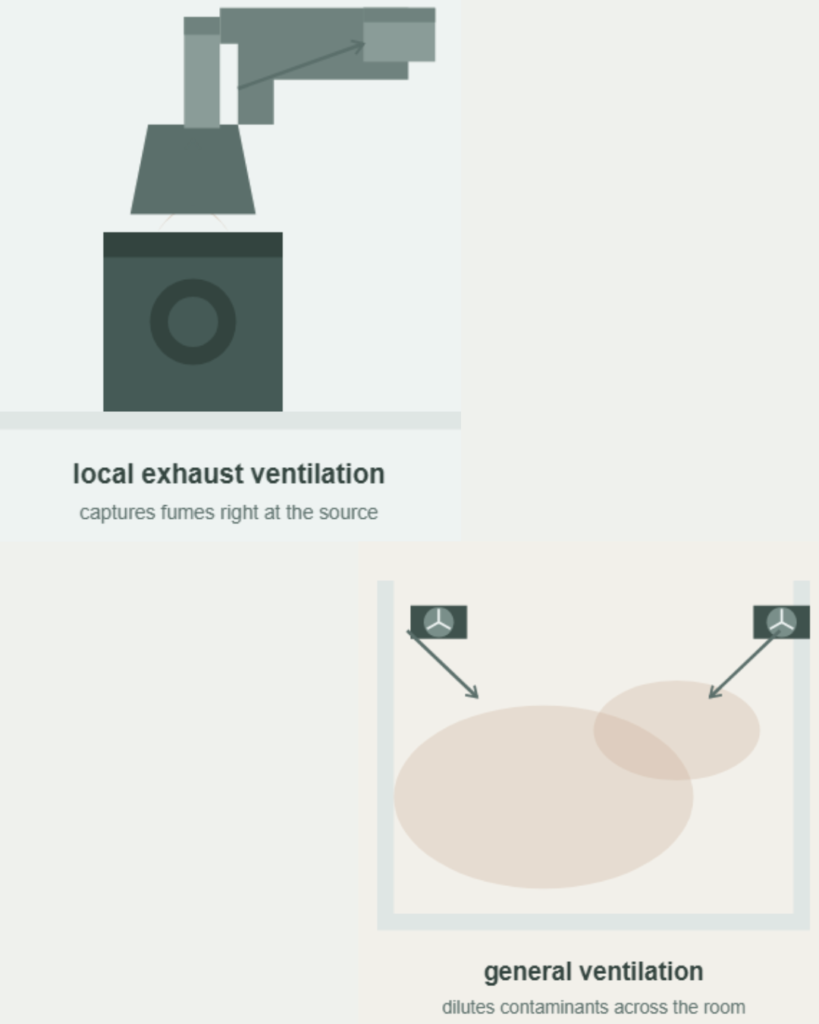
Local Exhaust Ventilation captures dust, fumes, vapours or gases close to where they are generated.
Typical examples include welding stations, grinding operations, chemical handling, and pharmaceutical processes.
The advantage is straightforward: the contaminant is captured before it spreads through the workplace.
General Ventilation: Manage the Space
General ventilation works across the wider work area. It supplies and removes air to reduce contaminant concentration and manage conditions such as heat, humidity and general air quality.
It is useful when contaminants are widely distributed or when controlling the overall environment is the primary objective.
LEV vs. General Ventilation
Local Exhaust Ventilation | General Ventilation | |
Primary objective | Capture at source | Dilute and replace room air |
Coverage | Specific process | Entire work area |
Typical application | Dust, fumes, vapours | Heat, humidity, general air quality |
Approach | Targeted | Area-wide |
Design for the Risk, Not the Equipment
One of the mistakes I see in industrial projects is treating ventilation as an equipment-selection exercise.
A larger fan does not automatically mean better ventilation.
If a hazardous contaminant is generated at a specific process, the project should first consider whether it can be captured at source. General ventilation can then support the overall workplace environment.
This approach can also influence energy consumption, equipment sizing, maintenance requirements and worker exposure.
Good ventilation design begins with understanding the process, not choosing the fan.
For project managers and engineering leaders, bringing this decision into the early design stage can prevent expensive modifications later and create a ventilation system that is easier to operate, maintain and manage.
Final Thought
LEV and general ventilation are not competing solutions. In many industrial facilities, they work best together.
The important decision is knowing what needs to be captured, what needs to be diluted, and where each approach makes engineering sense.