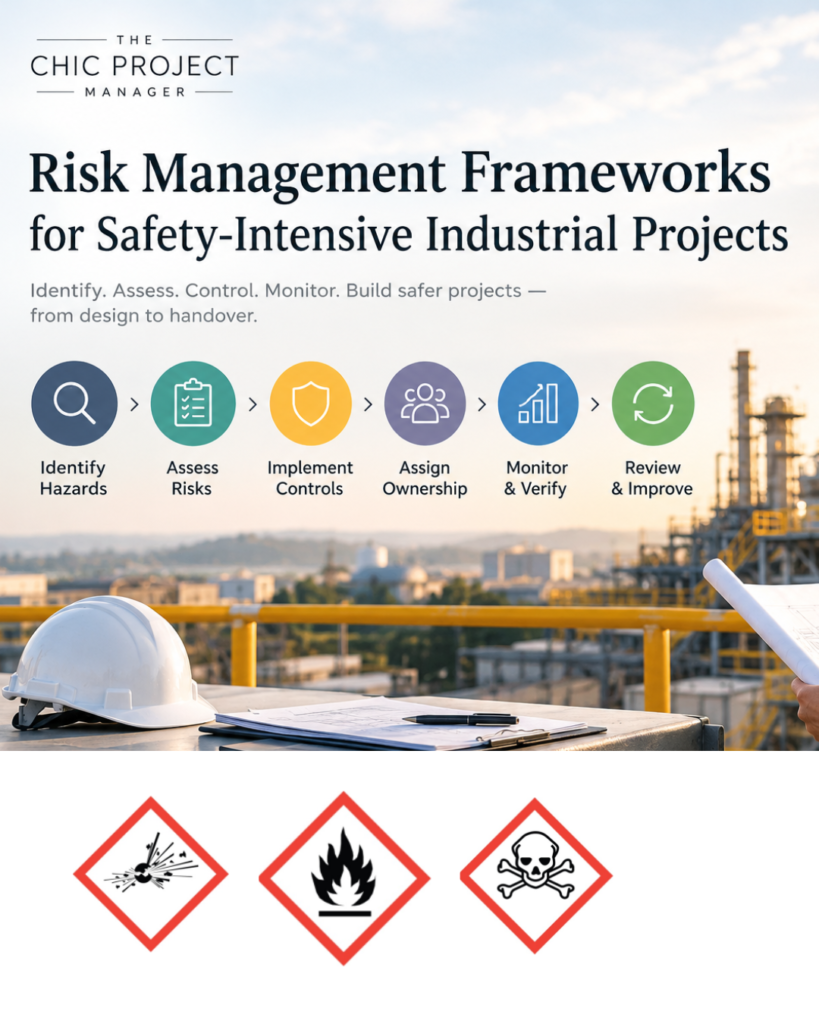
Risk Management Frameworks for Safety-Intensive Industrial Projects
Safety-intensive industrial projects are different from ordinary construction or engineering projects. A delay may affect the schedule. A procurement mistake may increase the budget. But a poorly identified safety risk can affect people, equipment, production, the environment, and the long-term viability of the facility.
This is why risk management cannot be treated as a safety department’s responsibility alone.
For a project manager, safety risk needs to be considered alongside scope, cost, schedule, quality, procurement, commissioning, and operational readiness.
The objective is to identify significant risks early, understand their consequences, put effective controls in place, and continuously verify that those controls are working.
What Makes a Project Safety-Intensive?
Safety-intensive projects typically involve processes, equipment, materials, or operating conditions where failures can have serious consequences.
Examples include:
Chemical and petrochemical plants
Oil and gas facilities
Power generation projects
Steel and metal processing plants
Pharmaceutical manufacturing facilities
Food processing plants with combustible dust risks
Mining and mineral processing facilities
High-temperature industrial processes
Hydrogen and other energy projects
Large-scale manufacturing facilities
These projects often involve multiple contractors, complex interfaces, hazardous energy sources, regulatory requirements, and equipment that must perform reliably under demanding conditions.
The risk picture can also change significantly as the project moves from design to construction and finally to operation.
That is why risk management needs to evolve with the project.
Why Traditional Risk Registers Are Not Enough
Most project managers are familiar with a risk register.
A typical register may contain:
Risk | Probability | Impact | Mitigation | Owner |
Equipment delivery delay | Medium | High | Alternate supplier | Procurement |
Design change | Medium | Medium | Design review | Engineering |
Contractor delay | High | Medium | Schedule monitoring | Project Manager |
This is useful, but safety-intensive projects require another level of thinking.
A safety risk should not simply be assigned a probability and impact score.
Risk Management Framework
A strong framework can be built around six stages:
- Identify hazards and risks
↓
2. Assess and prioritize risks
↓
3. Define risk controls
↓
4. Assign ownership and accountability
↓
5. Monitor and verify controls
↓
6. Review, learn, and update
The important point is that this is a continuous cycle, not a one-time workshop.
1. Start Risk Management During Concept and Design
One of the most common project mistakes is waiting until construction to address safety risks. By then, many important decisions have already been made.
Equipment layouts are fixed. Major equipment has been ordered. Process routes are established. Access arrangements may be difficult to change.
Risk management should therefore begin during the earliest project stages.
At concept and front-end engineering stages, ask questions such as:
- What hazardous materials will be handled?
- What energy sources are present?
- What could cause a fire, explosion, release, or equipment failure?
- What maintenance activities will be required?
- How will operators access equipment?
- How will isolation and lockout be performed?
- What happens during abnormal operating conditions?
- What happens during startup and shutdown?
- Can maintenance activities introduce new hazards?
- What environmental conditions can affect equipment performance?
A design decision made early can remove a hazard more effectively than a safety procedure added later.
2. Use Structured Hazard Identification
Different risks require different analytical methods. Depending on the project, the risk management framework may include:
HAZID — Hazard Identification
HAZID is generally used early to identify major hazards associated with the project, process, location, equipment, and activities.
It provides a high-level view of what could go wrong before detailed engineering is completed.
HAZOP — Hazard and Operability Study
HAZOP examines process deviations systematically.
Typical guidewords include:
- No
- More
- Less
- Reverse
- As well as
- Part of
For example, a process team might examine what could happen if flow is more than intended, pressure is higher than expected, or a particular component has no flow.
FMEA / FMECA
Failure Mode and Effects Analysis focuses on how individual equipment or components can fail and what those failures mean for the system.
This can be particularly useful for critical equipment.
What-If Analysis
This approach asks practical questions such as:
What if the cooling system fails?
What if the power supply is interrupted?
What if an isolation valve is left open?
It can be relatively simple and useful when combined with experienced project and operations personnel.
3. Apply the Hierarchy of Controls
Not every mitigation measure is equally effective.
A project team should prioritize controls using the Hierarchy of Controls.
The general order is:
- Elimination
- Substitution
- Engineering controls
- Administrative controls
- Personal protective equipment
This hierarchy has an important project-management implication.
If a hazard can be eliminated through design, that is generally preferable to relying on an operator to remember a procedure every time.
For example, consider a maintenance access problem.
A weak solution may be:
“Workers must use fall protection.”
A stronger project solution may involve redesigning the access arrangement to eliminate the need for routine work at height.
The second solution may require more engineering effort upfront but can reduce operational risk for years.
4. Separate Design Risks from Construction Risks
Industrial projects often focus heavily on operational hazards while overlooking construction-phase risks.
But the construction phase introduces its own risk profile.
Examples include:
- Heavy lifting
- Temporary structures
- Electrical work
- Hot work
- Confined spaces
- Work at height
- Excavation
- Temporary power
- Simultaneous operations
- Contractor interfaces
- Equipment installation
- Commissioning activities
A project may therefore require separate but connected risk registers for:
Design → Procurement → Construction → Commissioning → Operations
This helps prevent a common problem: assuming that a risk addressed during design remains controlled during construction.
5. Pay Particular Attention to Interfaces
Some of the most difficult risks occur between organizations rather than within them.
Consider a project involving:
- EPC contractor
- Equipment suppliers
- Civil contractor
- Electrical contractor
- Instrumentation contractor
- Mechanical contractor
- Operations team
- Maintenance team
Each organization may have its own procedures.
The problem occurs at the interfaces.
Who is responsible for isolating equipment?
Who verifies the isolation?
Who approves energization?
Who owns a system during commissioning?
Who is responsible when two contractors are working simultaneously in the same area?
These questions need clear answers before work begins.
A good project risk framework therefore includes an interface responsibility matrix, not just a list of hazards.
6. Treat Procurement as a Risk-Control Activity
Procurement decisions can create safety consequences long after the purchasing team has closed the purchase order.
For safety-critical equipment, project teams should consider more than price and delivery.
Questions should include:
- Does the equipment meet the required standards?
- Is the supplier technically qualified?
- Has the equipment been used in comparable applications?
- Are critical components appropriately specified?
- Is documentation complete?
- Are inspection and testing requirements defined?
- Are spare parts available?
- Is maintenance support available?
- Are certificates and test records required?
- What happens if the equipment fails?
For critical equipment, technical assurance should be part of procurement risk management.
A cheaper component that creates repeated failures may ultimately cost far more than its purchase-price saving.
7. Define Critical Controls
Not every mitigation measure deserves the same level of monitoring.
Some controls are critical because their failure could lead directly to a major incident.
Examples might include:
- Emergency shutdown systems
- Pressure relief systems
- Fire detection and suppression
- Gas detection
- Interlocks
- Guarding
- Explosion protection systems
- Ventilation systems
- Safety instrumented functions
- Electrical protection systems
For these controls, the project team should clearly define:
What is the control?
What hazard does it prevent or reduce?
Who owns it?
How is it tested?
What acceptance criteria apply?
How do we know it remains functional?
This converts safety from a statement of intent into something that can actually be verified.
8. Build Safety Into the Project Schedule
Safety activities should not sit outside the project schedule. They need defined milestones.
For example:
Project Stage | Safety Activity |
Concept | Preliminary hazard identification |
Basic engineering | Risk assessment |
Detailed engineering | HAZOP / design reviews |
Procurement | Technical specification and supplier review |
Construction | Method statements and task risk assessments |
Installation | Inspection and verification |
Pre-commissioning | Safety-system testing |
Commissioning | Functional testing and operational readiness |
Handover | Documentation and training |
This is particularly important during commissioning.
Projects sometimes become schedule-driven toward the end, and safety verification can get compressed.
That is precisely when discipline needs to increase, not decrease.
9. Monitor Risk
A risk register can look excellent on paper while the actual risk remains high.
For example:
Risk: Inadequate extraction from a hazardous process area.
Action: Install ventilation system.
Status: Closed.
But several questions remain:
- Was the system correctly sized?
- Has airflow been tested?
- Is the required pressure differential achieved?
- Are alarms functional?
- Has balancing been completed?
- Is the system performing under actual operating conditions?
- Who owns the ongoing inspection?
The action may be technically “closed” while the risk control has not been demonstrated.
For safety-critical controls, project managers should distinguish between:
Action completed and risk control verified.
That distinction can make a significant difference.
10. Use Leading and Lagging Indicators
Traditional safety metrics often focus on incidents.
These are lagging indicators.
Examples include:
- Recordable injuries
- Lost-time incidents
- Equipment damage
- Environmental releases
- Fires
- Process incidents
They are important, but they tell you what has already happened.
Leading indicators provide an earlier warning.
Examples include:
- Percentage of safety-critical inspections completed
- Number of overdue risk-control actions
- HAZOP actions closed on time
- Safety-system test completion
- Contractor training completion
- Permit-to-work compliance
- Safety audit findings
- Near-miss reporting
- Critical equipment inspection status
For project managers, leading indicators are particularly useful because they provide an opportunity to intervene before an incident occurs.
11. Manage Change as a Safety Risk
Industrial projects rarely follow the original plan exactly.
There will be:
- Design changes
- Equipment substitutions
- Layout changes
- Schedule acceleration
- Material changes
- Supplier changes
- Process modifications
- Contractor changes
The danger is assuming that a change is “minor” because it does not significantly affect cost or schedule.
A small engineering change can introduce a major safety consequence.
A formal Management of Change (MOC) process should therefore consider:
What is changing?
Why is it changing?
What hazards could the change introduce?
Does the existing risk assessment remain valid?
Do drawings, procedures, training, and emergency plans need updating?
No significant safety-related change should disappear into email threads.
12. Include Human Factor
Industrial safety is not only about equipment.
People interact with the system every day.
A technically excellent design can still create operational risk if it is difficult to understand or maintain.
Human factors considerations include:
- Equipment accessibility
- Control-room layout
- Alarm management
- Visibility
- Labeling
- Ergonomics
- Maintenance access
- Procedure complexity
- Operator workload
- Emergency response
- Training requirements
A useful project question is:
“What will this look like to the person operating or maintaining it at 3 a.m.?”
That question often exposes practical problems that a design review may miss.
13. Establish Clear Risk Ownership
A risk without an owner is effectively an unresolved risk.
However, ownership should not mean simply assigning someone’s name to a spreadsheet.
The risk owner needs enough authority to influence the outcome.
For example:
- Design risk → Engineering Manager
- Procurement risk → Procurement Lead
- Construction risk → Construction Manager
- Commissioning risk → Commissioning Manager
- Operational readiness risk → Operations Manager
The Project Manager’s role is to ensure that these owners are actively managing the risks and that unresolved high-risk issues reach the appropriate decision-makers.
14. Create a Risk Escalation System
Not every risk needs senior-management attention.
But certain risks should automatically trigger escalation.
A practical framework can classify risks as:
Low
Manage within the project team.
Medium
Monitor regularly and assign specific mitigation actions.
High
Require management attention, defined controls, and frequent review.
Critical
Require immediate escalation and formal decision-making before proceeding.
The exact scoring method can vary by organization.
What matters is that the escalation rules are understood before a serious issue occurs.
15. Close the Loop During Project Handover
One of the biggest gaps in industrial projects occurs at handover.
The project team may consider the project complete once the equipment is commissioned.
Operations may see things differently.
They need:
- Updated drawings
- Operating procedures
- Maintenance instructions
- Safety-system documentation
- Inspection requirements
- Training
- Spare-parts information
- Test certificates
- Equipment records
- Outstanding-risk information
The final risk register should not disappear when the project closes.
Relevant residual risks need to be transferred to the operating organization.
Final Thoughts
Safety-intensive industrial projects require a different approach to project risk management.
The objective is to make risk visible early enough that the project team can do something about it.
The most effective framework connects engineering decisions, procurement, construction, commissioning, operations, human factors, and management accountability.
And perhaps most importantly, safety should not be treated as something that is added to a project after the design is complete.
Good risk management starts by asking how the project should be designed, not just how the finished project should be protected.
For project managers working in industrial environments, that shift in thinking can improve not only safety performance, but also reliability, cost control, schedule confidence, and long-term project value.